Wednesday, 15 April 2015

Economic development through promotion of SMEs

Many economies have lagged behind in the promotion of SMEs and have missed the benefits they bring in a nation. Rather, nations have been supporting large scale projects and large companies, which is a good policy but not enough for maximum development of the nation.
promoting SMEs to accelerate growth
 According to financial Gazette, to develop well there are five ingredients for success which include, exploring sector specific knowledge, efficient processing of products that at standard and legal, unique product structures, integrated technical assistance (Entrepreneurs required to work with mentors in their ventures and should aim to improve value-added and profitability) and alignment of interests.
SMEs play a key role in transition and developing the country. This firm typically accounts for more than 90% of all firms out side the agriculture sector constitute a major source of employment and generate significant and export earning. As much , SMEs development emerge as a key instrument in poverty reduction efforts.
SNV is dedicated to a society where all people enjoy the freedom to pursue their own sustainable development. Our advisors contribute to this by strengthening the capacity of local organizations.
Swiss-connect to promote SMEs
SNV is committed to catalysing impact through the promotion and improvement of income-generation, employment and production(through competitive, value-added market chains)for low income communities and increasing the access and sustainability of basic services with a
particular concentration in health, education, water and sanitation and renewable energy for these
undeserved communities.

Zim needs SMEs exports promotion agency.

The European commission came up with with various legislation aimed at promoting successful entrepreneurship and improve the business environment for SMEs to allow them to realise  their potential in today`s global economy
 According to the Herald ,SMEs Export Promoting Agency to focus entirely of SMEs while Zim Trade concentrates on big Companies. The form specialization will bring better results .
President Mugabe and Zuma agree of Export trade between Zim and SA.
 Zimbabwe`s foreign trade promotion body, Zimtrade, has intensified efforts to boost trade to narrow the country’s widening trade deficit, blamed for a worsening liquidity crunch that has hamstrung economic revival.
The trade and export promotion body last week took Indian experts to Bulawayo who conducted a week-long training on international trade for companies in the city.
According to the , financial Gazette Association for Business in Zimbabwe (ABUZ) chief executive officer, Lucky Mlilo, said companies benefited from the training while paying tribute to ZimTrade for having organised the workshop.
“You would find that most companies face challenges in that area of exports and basically to do with the cultural obstacles that will be standing in between the two countries.
ICT announces launch of SME trade.
Small-scale manufactures dominate the size composition of Zimbabwe`s export such dominancehas not been reflected in policy prioritization, leaving small manufacturing exporters subject to the same treatment as the large manufacturers despite obvious different in capacity to respond and data.Although Zimbabwe`s manufactures export a wide diversity of products, such diversity is still not fully reflected in value-addition.Up to 25% of manufactures exports in this study that they export unfinished products.Exports admits exporting unfinished products is less profited but better than than turning down the orders.


to resp

Monday, 13 April 2015

Implications of an SME-based economy.

The government industrial policy has always supported the small to medium-scale enterprises (SMEs) as a vital economic sector. The SMEs have been a viable, yet subsidiary sector that complemented big business by supplying goods and services. Southern Eye indicates that the presence of the SME sector has been made possible by the government’s investment in practical subjects and entrepreneurship. Its emergence as a primary sector has been further catalysed unwittingly by the imposition of economic sanctions on Zimbabwe.
 The economic sanctions forced many big companies into liquid action and viability problems leading to widespread shutdowns or scaling down of operations, forcing retrenchment of tens of thousands of employees. Some of those who lost their jobs started their own businesses such as small-scale mining and farming, initiatives promoted by the government and aimed at benefiting Zimbabweans.
 indigenisation to prevail in Zimbabwe.
 Furthermore, Southern Eye mentions that SMEs now become the dominant sector which is responsible for providing the government revenue. The government needs to avoid revenue leakages from this sector by ensuring that it reforms and implements an appropriate and effective governance and tax collection system. The current level of revenues should be seen partly as a struggle by the government to collect taxes from an SME sector still adapting to a major economic structural change.
locals advised to grow more of local products
 However, that potential revenue loss would likely be temporary. As SMEs become more competitive and get a tighter grip of the economy, and as the new SME-based tax structure reaches and incorporates a majority of SMEs, revenue will likely improve. Importantly, the government will need to be more financially prudent so that their expenditure does not lead them to levy higher taxes to SMEs.


indigenisation and SMEs

One of the key assumptions that shaped my thinking around indigenisation was the belief that most people preferred formal employment to self-employment. The indigenisation policy has attracted the same tag as the land reform program: a good policy, but people are skeptical over whether or not it will be implemented well. Doomsday scenarios have been painted over the likely outcome of indigenizing Standard Chartered Bank or Zimplats
 If it is agreed that the role of government is to create an enabling environment, and that of the private sector is working within the environment so created to ensure economic prosperity, then surely the burden of implementation lies on us, the people.
The long and short is that indigenisation is an imperative, and it is going to happen whether or not people like it. No one disputes that it is a good policy, therefore we need to participate if we are to make it happen the way we would like to see it. The land reform program has seen over 250 000 families benefiting; we want to see the 2,8 million Zimbabwean SMEs come out winners from this round. Zimbabweans working in “affected” companies need to see it as an opportunity, not as a threat. As business associations and chambers we need to engage with Government and our members to ensure that this program succeeds resoundingly.
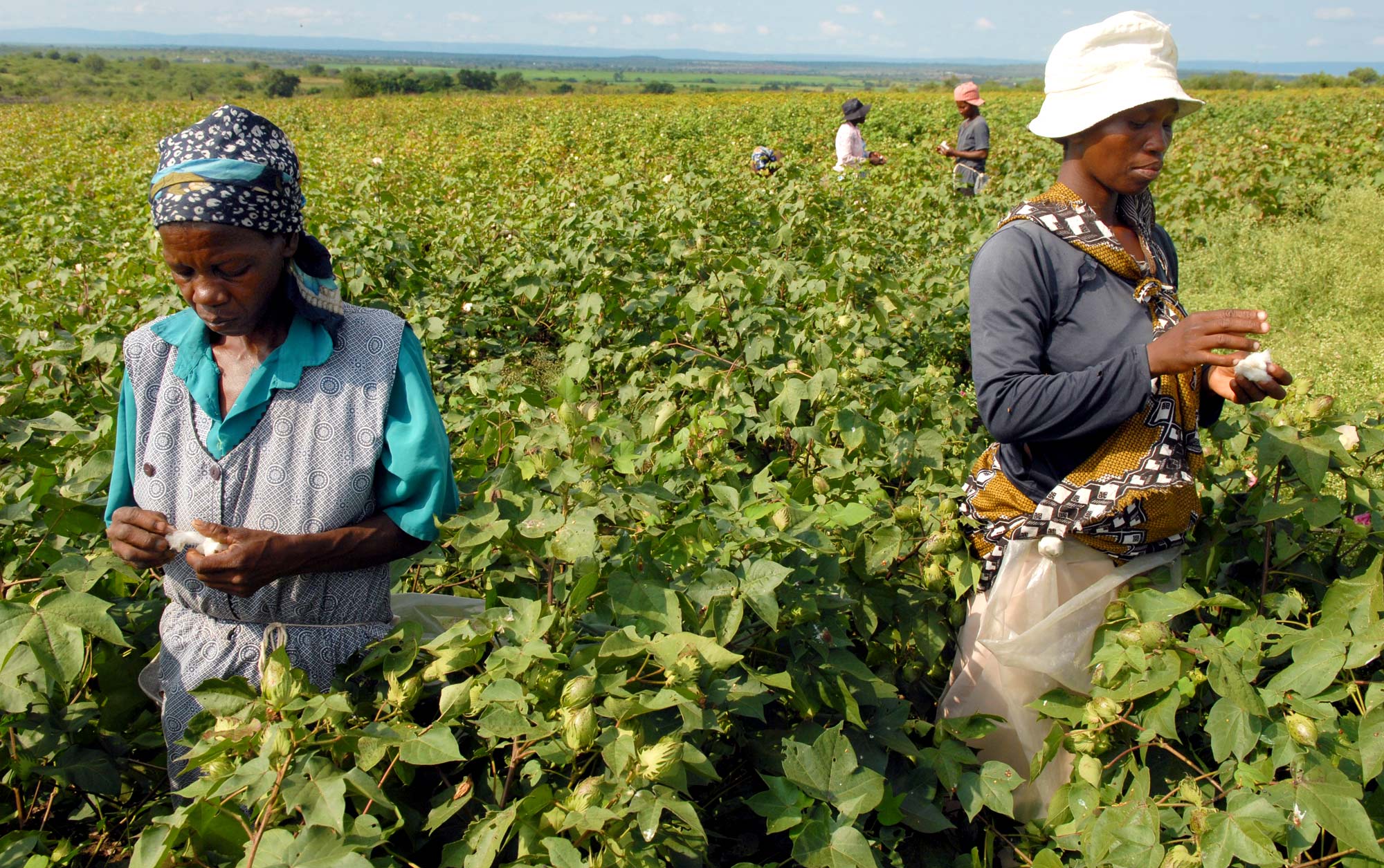
Workers picking cotton in Nkayi.
 According to the financial Gazette, Most executives of such foreign-owned institutions are not able to tailor solutions that are suitable for local conditions as they are under strict instruction from their parent head offices. Many also aid their foreign owners in carrying out activities such as transfer pricing, in exchange for personal perks and rewards. One would think that a person in such a position is better off advocating for localisation of their operation, but perhaps that inferiority complex sits deeper, even in more educated minds.

Monday, 6 April 2015

Major boost for SMEs

The contraction of economic activity and de-industrialisation has resulted in a thriving SMEs sector now widely seen as one of the viable sources of employment. Given the benefits of a vibrant SME sector to the economy, it is imperative that banks are supportive of this sector through tailored products including loans and advances especially supply contract and order financing.
According to the financial Gazette, he noble decision by the Central Bank comes at a time when more than 70 percent of the working population in Zimbabwe is believed to be self-employed but faces varying difficulties in funding. Small to medium scale enterprises, according to Ministry of Finance figures, account for 50 percent of Zimbabwe’s Gross Domestic Product.Microfinance and mobile money services are being seen as one of the solutions but not the sole answer to poverty alleviation.
Elizabeth Tabethe , SA Deputy minister in  conference.
SOUTH Africa has entered into an agreement with the local Ministry of Small and Medium Enterprises and Cooperatives to look at possibilities of reviving some of the identified distressed companies in Bulawayo.
This agreement will see local small to medium scale enterprises traveling to South Africa to learn best business practices and incubate ideas on how to grow their business ventures.
 According to local statistics, small to medium scale enterprises provide 60 percent to Zimbabwe’s gross domestic product and 50 percent of the country’s total employment, meaning the enterprise play a critical role in the livelihoods of people.
“It is therefore critical that we utilize the advantage of our geographical proximity to focus on targeted high growth markets with the objective of creating investment opportunities for Zimbabwe companies to partner with their South African counter parts to advance the export opportunities of Zimbabwean products,”said Elizabeth Thabethe  South African Deputy Minister of Trade and Industry.

Friday, 3 April 2015

why SMEs thrive not just survive

SMEs in Zimbabwe contribute approximately 90% to the growth of the country as per a report in 2011.Among the companies perhaps SMEs that have made it through the economic hardship is TM  
 TM Supermarkets is set to expand its branch network by opening an additional five new supermarkets across the country.Often, during the good economic times Banks, venture capitalists and investors are willing to invest in both SMEs and high growth enterprises.
Speaking during the official opening of the new TM Msasa Branch TM head of operations Lameck Kujeku said the group is will continue expanding its branch network across the country.
“Work is at various stages of completion at five other sites around the country and needless to say, that will generate significant benefits for all our stakeholders.
One of the SMEs thriving in Zimbabwe:Harare.
“It all demonstrates our confidence in our country and its economy and we shall intensify our efforts in this direction,” he said.

The project was completed with a total of $4, 5 million dollars which was contributed by both TM and Old Mutual, and is said to have created 200 new jobs.The completion of this project at a cost of more than $4, 5 million dollars has had the following impact on our country’s economy,” he said.
The new supermarket comprises of 6 600 square meters comprising of Food & Vegetables, Bakery, Butchery, Deli, Wholesale and Liquor Wholesale Centre.
TM currently has 48 supermarkets across the country.

 According to the Standard, the SMEs sector in Zimbabwe, which now accounts for about 90% of the country’s employable population, is in dire need for government and private sector assistance to secure more funding.
Since the use of mufti-currencies in 2009, most enterprises are struggling to survive due to lack of long-term financing.

Sunday, 29 March 2015

Informal Sectors offered cheap accounts.

know which bank to trust with your money.
Zb Bank if offering cheap accounts to all informal sectors. This is  the only bank ever in Zimbabwe that has ever offered cheap account. An account with Zb Bank is $2 only.However it must be mentioned that there are conditions that goes with it.According to their Public relations officers, Thamsanqa Mdlonga, a student at Nust said that there conditions that go along with them are that the business has to constantly deposit money and they are allowed to withdraw at least three times a week.
special initial allowances offered to SMEs.
In 2006, The reserve bank in partnership in stakeholders developed the financial inclusion framework in order to improve financial service to the marginalized in remote areas of the including SMEs.
According to the number of SMEs assessing loans from institutions from $5,658 as at 30 January 2013 to $9,067 as at 29 February 2014,representing a 60% increase. The value of loan disbursement from 208,66million as at 30 June 2013 to 211.02 as at 29 February 2014.
Special Initial Allowances are granted to any SME in terms of section 15(2) (c) as read with the fourth schedule paragraph 9 (g) of the Income Tax Act [Chapter 23:06].
An SIA is a capital allowance which ranks as a deduction. It has the effect of reducing the taxable amount and therefore the tax due from a business. This incentive enables the business to retain more of its earnings which can then be re-invested to grow the business.

Employment creation through SMEs

It must be mentioned that SMEs have contributed in the economic growth of Zimbabwe since the econimic melt down. The situation worsened in 2002
 The Bulawayo Light Engineering Project provides an avenue for small-scale entrepreneurs in Bulawayo and the broader Matabeleland Province to create economic self-reliance. This is achieved through a service centre where artisans hire time on precision machinery, as well as Business Shop, where capital goods are then sold.
The project is developing and testing a model for the creation of sustainable jobs and incomes among small-scale and marginalised artisans. It also seeks to increase opportunities for entrepreneurs to create or expand their businesses by making small-scale and affordable capital goods readily available. Ultimately, the model will be documented, shared and disseminated widely if successful.
employee at the first day of work
UNDP is supporting the institutional capacity of the Social Fund for Development.
Greater and wider benefits will, however, go to indirect beneficiaries. These consist of small enterprises that will purchase equipment and capital goods produced by artisans to start their own businesses. 20 small-scale capital goods consisting of maize grinding mills, peanut butter makers and candle moulds were sold during the year under review.
The main benefits consist of increased incomes for artisans and small producers that buy capital goods and start their own businesses. Some of the most successful artisans have reported monthly incomes in the region of £450-£1,000 per month. Jobs have also been created for unemployed people especially youth and women. These groups usually suffer more unemployment levels than men do. Each artisan who is a regular user of equipment provided by the service centre employs at least one assistant artisan. The project has therefore contributed to the creation of at least 200 sustainable jobs. 
According to the New Zimbabwe, the is need to promote collaboration between SMEs and large producers to create joint ventures, market access and buy-back arrangements, as well as promote skills transfer, technology development and marketing expertise.  However this will increase small business access to procurement opportunities and include them in the government supply chain. These opportunities will provide experience and income for local small businesses and thus enhance their potential for growth, development and employment creation.

Sunday, 22 March 2015

How to bulletproof your business from a bad economy.

2008 Econom,y, Zim Dollars losing value .
Even in times of economic growth, it’s challenging to grow a business.It is important to have a good leader at the first place. Research shows that people placed in positions of authority often become less mindful of others’ feelings and needs. Meanwhile, those in subordinate roles devote immense energy to watching and interpreting the actions of leaders. These tendencies make for a toxic tandem, which is only exacerbated during a crisis.
 Sutton, a Stanford professor, provides a useful framework to get bosses focused on what their people need from them most. In a situation where people feel threatened, a good boss finds ways to provide more predictability, understanding, control, and compassion.
empty shelves during the 2008 economy.
Predictability. Give people as much information as you can about what will happen to them and when. Preparation will reduce their suffering, and they can relax in the meantime—as Londoners during the blitz were able to do when the air-raid sirens were silent. It is also important for a company to stay positive at all time. It is necessary to minimize work- space injuries by meeting  with the employee and offer him a light-duty job the worker can do while he's healing rather than to leave the injured to consult with the attorneys.
It necessary to keep your customers happy by telling them what they've gained from using your products or services in presentations or informal conversations, your sources can encourage others to use your products or services hence it will keep them coming back.Also there is need to reduce vacation.


Wednesday, 18 March 2015

Role of Banks in promoting growth.

Banks play a major role in the growth of SMEs. It must be mentioned that one is able to acquire a loan in Zimbabwe to improve his of her business on the run.Companies like CB Bank also cater for these SMEs by proving them with free bank accounts. CB  is among the few banks left that is helping Informal sector.However, in partnering with the NUST public relations student  they will host a campaign at NUST next week Monday on the 23th of March.
  At Standard Chartered, you will have a team of dedicated professionals helping you with every aspect of your business needs: from making your banking transactions easy and convenient to providing you with business credit. Whatever your business needs, you can count on our support for providing the right material to build and develop your business.
A Boutique that came to exist through the help of banks.
CBZ has objectives and they are as follows  The objective of this department is to provide financial services to the economically active informal sector that are unable to access mainstream facilities while creating employment and alleviating poverty at cost effective rates.
Procedures to acquire an accounts allows one to constantly deposit  money at-least three times a day.
sMEs are recognised as one of the key drivers of ZimAsset and an engine for economic growth by virtue of their contributions to employment and wealth creation, income generation and strategies ,linkages with large companies across economic clusters.
 Kingdom bank used  Promotion of small and Medium Enterprises (SMEs) in Zimbabwe through Microfinance Institutions(MFIs)
Government has in the past made various facilities available for SMEs through the Reserve Bank of Zimbabwe and the National Social Security Authority. However, the private sector, financial institutions, life assurance companies and institutional investors have been conspicuous by their absence.
Commercial banks such as Barclays Bank of Zimbabwe used to have a Small Business Unit (SBU) which they closed down over a decade ago.